Posts

Germs Inc. and the Butterfly Effect
Image
A new strain of a CoronaVirus is reportedly wreaking havoc in China, and has supposedly spread to over ten countries (including in Europe). This virus is said to have originated in snakes or bats and tramistted to humans in the food market in Wuhan, but there is no dearth of alternative explanations as regards to the provenance of this killer.  The propensity of the Chinese to keep things bottled up is well known, and just the fact that they are opening up about this super-virus serves as a good indicator of how widespread the threat truly is. There is a nation-wide ban on wildlife trade as a result, and over 56 million people in 20 cities have been effectively quarantined via travel restrictions. While officially infections are said to be restricted to under 2,000 people, there are some reports from alleged ' whistle-blowers ' who peg the number at nearly 90,000 patients.  While no one really knows how much toll this virus will extract, I do think the impact of lar...

Debt-plomacy, or How China Eats The World

Image
The rise of China has been the defining force of the last 15-20 years. Its economic miracle built on the back of debt and liquidity, and investing for an export driven economy drove commodity prices, and indeed global geopolitics. Its worth noting that per some estimates China's total debt today tops 300% of its GDP, and at an estimated US$40 trillion accounts for 15% of all global debt. But arguably, the export miracle never really materialised with net exports accounting for only about 2% of the total rise in GDP between 2006 and 2019. However there is another aspect of the China story which, albeit not ignored, is not as appreciated as one believes it should be. This pertains to Chinese investments in other countries, a strategy that appears to be driven more more by foreign policy, than economic considerations. These have totaled a staggering US$ 2 trillion in the last 15 years, as per data compiled by the American Enterprise Institute and The Heritage F...

India: Journey to US$5 trillion

Image
It is the stated goal of PM Narendra Modi to make India a US$ 5 trillion economy by the year FY 2025. For perspective, India's nominal GDP stands at US$2.7 trillion in FY 2019, suggesting that a Cagr of 10.7% would be required over the next 5-6 years to achieve this target.  For a better understanding of this journey, I decided to look at China for guidance. China had a ~US$2.7 trillion GDP in the year 2006, and managed to achieve a US$5 trillion in just three years (by 2009). A scorching GDP Cagr of 22.9%.  What stood out for me is how little "exports" contributed to this rapid rise in the GDP for China. This is particularly interesting because for those who even cursorily followed economic news around this time, primarily knew China as an export miracle.  In reality, increase in exports contributed only 0.5% of the total increase in GDP between 2006 and 2009. Yes, just US$12bn of the GDP increase came from net exports. The primary driver for China...

September 2019 Inflation print, nothing alarming

Image
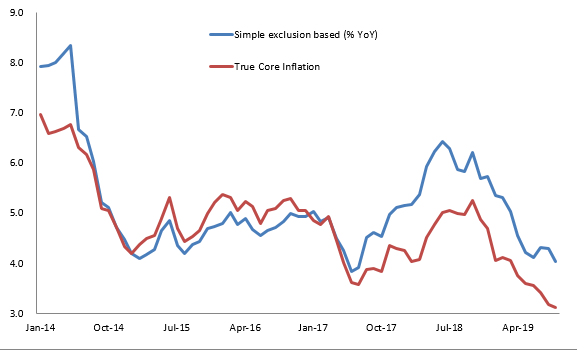
The latest reading of the Indian CPI (Sept 2019) came out at 3.99%. This may cause some re-think within policy circles on the current rate reduction cycle. However, a closer look at the data suggests that there is nothing alarming about this print. First, it is still slightly below the target inflation of 4% (-/+ 2ppt). Second, the core inflation, even as its calculated using exclusion method has actually come down from 4.3% in Aug19 to 4% in Sept. Finally, if we were to use my true core measure (i.e. excluding items based on their actual volatility and not just the food+fuel exclusion), then the core inflation has come down to 3.11% in Sep-19 from 4.69% in Dec-18. In fact the core inflation continues its downtrend unabated as seen below: The rise in inflation in September 2019 was due to a surge in volatile items. Notably, despite this surge the volatile inflation has not broken above the technical downward trend line. Given where it is poised today, I believe it will ho...

Musings on the Taylor Rule

Image
Summary: While admittedly RBI does not strictly follow the Taylor rule, it is a useful tool in analyzing policy. The current rate stance of RBI implies a trend growth rate of only about 3%, a sharp discount to long term growth target of 7%. RBI would need to cut rates by over 200 bps to reach a level where trend growth of 7% can be accommodated under the Taylor Rule mechanism. While at the current anemic cut size of 25 bps each review cycle, it would take well over a year to reach this level. Analysis of its past rate cuts using the Taylor formula suggests that RBI has been more reactive to output gaps than inflation gaps. This is in itself surprising given how much of the chatter around policy announcements is dominated by inflation data. Given that India is today facing a favourable inflationary gap, as well as negative output gap, it is intriguing to note RBI's continuing gradual approach to monetary policy. On the backdrop of another anemic cut in rates by the Reserve Bank...

PMC Bank fiasco: Predictable?

Image
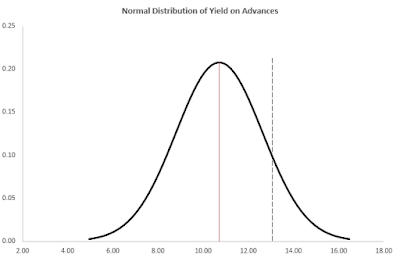
Punjab Maharashtra Cooperative Bank (PMC) is latest in the series of bad news emanating from the Indian banking sector. While this was a result of misfeasance by PMC bank's management and thus not systemic in that sense, it does raise question marks on the audit and scrutiny procedures of the Reserve Bank of India (RBI). The details of the scam and how the management hid it, can be read from this link  for those interested. So, was it possible to gauge that the books of PMC were not really kosher? To examine this issue, this author made a series of bell curves in MS- Excel of select financial data for a sample universe of 54 Urban Cooperative Banks, the peer group of PMC. The data was obtained from the RBI website. The bell curve will allow us to easily juxtapose the select financial data for PMC vis-a-vis the average data for the universe of its peer group. The central brown/ golden line denotes the average of the data being studied in each graph. For exa...

China's failed 'Corbomite maneuver'

Image
For those not as embarrassingly familiar with Star Trek lore as this author, the Corbomite maneuver is a bluff used by Captain Kirk to get out of a sticky situation. In an episode when the Starship Enterprise is faced with a powerful adversary, the captain threats to use a non-existent 'corbomite' device on board his ship to destroy the enemy. The adversary, unable to take the risk that such a device may actually not exist, relents and Kirk and his crew of 428 live to fight another day.  Matters however will have ended very differently (and the series rendered awfully short) had the enemy called Kirk's bluff. This is a bit like what is going on with China and its holdings of US treasuries at the moment. China is one of the largest holders of US debt, along with Japan. The situation (albeit from April 2019) looked a little something like this: Source: The Visual Capitalist There has been some chatter recently (and indeed keeps coming up from time to tim...