Posts

September 2019 Inflation print, nothing alarming
Image
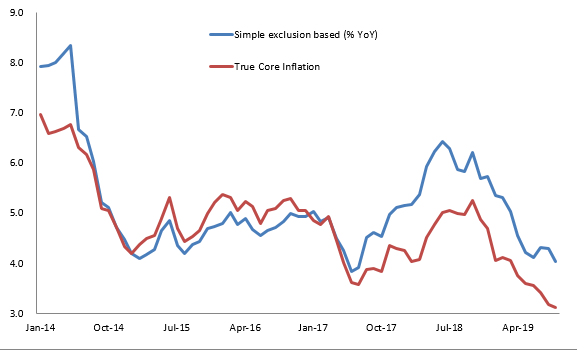
The latest reading of the Indian CPI (Sept 2019) came out at 3.99%. This may cause some re-think within policy circles on the current rate reduction cycle. However, a closer look at the data suggests that there is nothing alarming about this print. First, it is still slightly below the target inflation of 4% (-/+ 2ppt). Second, the core inflation, even as its calculated using exclusion method has actually come down from 4.3% in Aug19 to 4% in Sept. Finally, if we were to use my true core measure (i.e. excluding items based on their actual volatility and not just the food+fuel exclusion), then the core inflation has come down to 3.11% in Sep-19 from 4.69% in Dec-18. In fact the core inflation continues its downtrend unabated as seen below: The rise in inflation in September 2019 was due to a surge in volatile items. Notably, despite this surge the volatile inflation has not broken above the technical downward trend line. Given where it is poised today, I believe it will ho...

Musings on the Taylor Rule

Image
Summary: While admittedly RBI does not strictly follow the Taylor rule, it is a useful tool in analyzing policy. The current rate stance of RBI implies a trend growth rate of only about 3%, a sharp discount to long term growth target of 7%. RBI would need to cut rates by over 200 bps to reach a level where trend growth of 7% can be accommodated under the Taylor Rule mechanism. While at the current anemic cut size of 25 bps each review cycle, it would take well over a year to reach this level. Analysis of its past rate cuts using the Taylor formula suggests that RBI has been more reactive to output gaps than inflation gaps. This is in itself surprising given how much of the chatter around policy announcements is dominated by inflation data. Given that India is today facing a favourable inflationary gap, as well as negative output gap, it is intriguing to note RBI's continuing gradual approach to monetary policy. On the backdrop of another anemic cut in rates by the Reserve Bank...

PMC Bank fiasco: Predictable?

Image
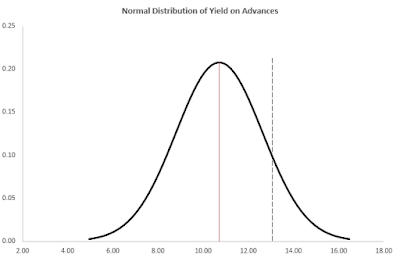
Punjab Maharashtra Cooperative Bank (PMC) is latest in the series of bad news emanating from the Indian banking sector. While this was a result of misfeasance by PMC bank's management and thus not systemic in that sense, it does raise question marks on the audit and scrutiny procedures of the Reserve Bank of India (RBI). The details of the scam and how the management hid it, can be read from this link  for those interested. So, was it possible to gauge that the books of PMC were not really kosher? To examine this issue, this author made a series of bell curves in MS- Excel of select financial data for a sample universe of 54 Urban Cooperative Banks, the peer group of PMC. The data was obtained from the RBI website. The bell curve will allow us to easily juxtapose the select financial data for PMC vis-a-vis the average data for the universe of its peer group. The central brown/ golden line denotes the average of the data being studied in each graph. For exa...

China's failed 'Corbomite maneuver'

Image
For those not as embarrassingly familiar with Star Trek lore as this author, the Corbomite maneuver is a bluff used by Captain Kirk to get out of a sticky situation. In an episode when the Starship Enterprise is faced with a powerful adversary, the captain threats to use a non-existent 'corbomite' device on board his ship to destroy the enemy. The adversary, unable to take the risk that such a device may actually not exist, relents and Kirk and his crew of 428 live to fight another day.  Matters however will have ended very differently (and the series rendered awfully short) had the enemy called Kirk's bluff. This is a bit like what is going on with China and its holdings of US treasuries at the moment. China is one of the largest holders of US debt, along with Japan. The situation (albeit from April 2019) looked a little something like this: Source: The Visual Capitalist There has been some chatter recently (and indeed keeps coming up from time to tim...

The curious case of Raghuram Rajan

Image
Rahguram Rajan (RR) is indeed a well known personality from the field of global economics. The son of a bureaucrat in India, RR went on to study in some of the most elite universities in the world. He came to be associated closely from Indian economic policy-making in 2007 when he worked with Montek Singh Ahluwalia on financial sector reforms. In 2008, he assumed the role of honorary economic advisor, a role he presumably served till his appointment as the Chief Economic Adviser to the Indian Ministry of Finance. In 2013 he took over as the governor of the Indian central Bank, the Reserve Bank of India and remained in the role till 2016 when reportedly his teaching duties in the USA beckoned and he left. While, this description can be read by anyone on RR's wiki page (as I have), the point I endeavor to make here is that RR was closely associated with India's economic policy at the very highest levels from 2007 to 2016, nearly a decade . He also has the distinction of being p...

Capacity Utilization, the devil in the details

Image
Summary: Data indicating higher capacity utilization (CU) is misleading. This author believes that higher CU is reflective of lower capacity additions over the past decade than of any meaningful increase in demand. An innovative analysis of inventory data released by the RBI suggests that corporates too do not appear to be in the mood to crank up activity. This author believes that any government stimulus package that focuses on higher government spend, and tweaking of GST rates will be akin to pushing on a string. To make a meaningful difference to economic activity needs a  two pronged solution, a) ease capital constraints at banks, and b) put more disposable income in the hands of the ultimate consumer by slashing direct taxes. About ten days ago, the Reserve Bank of India released the results of its OBICUS survey on capacity utilization, that indicates capacity sweating in 4QFY19 was the highest in the last five years: While this has been seen by some as a sign o...

July 2019 Inflation, the doves should soar

Image
Head-line CPI in India came out at 3.15% YY, vs. 3.18% YY in the previous month. The rise in the July headline was driven primarily by four sub-indices, housing (4.9% YY), health (8%), meat (9.1%), and education (6.4%) respectively. Fruits (-0.9%), sugar (-2.1%), fuel (-0.4%), saw a decline on an annual basis. The comforting news here remains that Indian inflation has remained well below RBI's median target of 4%, for 12 consecutive months now. Core inflation as conventionally measured (exclusion based) rose marginally to 4.3% YY (from 4.1% YY in June 2019). There is likely to be some consternation regarding this rise, albeit its small quantum, given that the increase comes after a 6 month falling trend in the core number. However, it is this author's contention, and has been for quite sometime now,  that the core measure being used is not optimal. As such, I would defer to my "true core" measure that is calculated by removing the actual volatile items f...